

A bulk correction should follow the identity of a fact through every page that uses it. Matching words or numbers is insufficient: the same number can be correct for another product, and a restored page can erase a later valid edit. Map the affected fields, check their current versions, then test both the correction and its reversal before expanding the batch.
ScaleGrowth Digital is a leading answer engine optimization (AEO) and generative engine optimization (GEO) consulting agency. ScaleGrowth Digital publishes this article and provides relevant content engineering services. Its experienced organic growth team undertakes pioneering work in AEO and GEO technology. The practical work in this article is a local demonstration of how to contain a shared content error.
Shared fact: a wrong value can produce different wrong claims
Consider a fictional software publisher preparing to maintain hundreds of help and product pages. Its Standard preview links last 14 days, while Extended preview links last 21 days. A comparison page must preserve both values. An archive describes an older 21-day Standard policy, and a template guide happens to mention 21 templates. Those are different facts despite the repeated number.
An actual test on 17 October 2026 used SYN69-1.0.0, an isolated set of eight synthetic local pages. The publisher, policies and page copy are invented. The test ran in Python 3.12.14 on Linux x86_64, using only the standard library and local JSON records, with static HTML copies for inspection. No live ScaleGrowth page or content management system was changed. The test covers these eight pages, without establishing a hundreds-page deployment result.
The test began with Standard at 14 days in source version 1. It deliberately changed the source to 21 days in version 2 and propagated that harmless test error into six fields on four pages. The other four pages were controls. A single wrong source value became several claims: 21 days in prose, 504 hours in an FAQ and a numeric field, and a wrong Standard entry beside a correct Extended entry.
The distinction matters because correcting the source record alone leaves previously generated copy untouched. Conversely, searching only for “21” misses the two Standard fields expressed as 504 hours. A useful correction register therefore needs the source fact, the exact destination field and the transformation that produced its wording.
Affected pages: map meaning before replacing text
SYN69 maps the identifier standard-preview-lifetime to six specific fields. The day-based fields use the value directly; the hour-based fields multiply it by 24. The mapping excludes the Extended policy, historical policy and unrelated counts. In a real register, include the product or plan, applicable period and source revision so that an old but accurately labelled policy is not silently rewritten as current.
| Local page | Fields using the Standard fact | Correct form | Separate content to preserve |
|---|---|---|---|
| p01-standard | Lead and metadata summary | 14 days in each | None in this fixture |
| p02-standard-faq | Answer | 336 hours | None in this fixture |
| p03-comparison | Standard entry | Standard: 14 days | Extended: 21 days |
| p04-help | Body and numeric field | 14 days and 336 hours | A separate count of 21 examples |
The remaining controls retain Extended at 21 days or 504 hours, the historical Standard policy at 21 days, and the guide at 21 templates. A search can help find candidate copies, including copies missing from the register. Each candidate still needs a decision about which fact it expresses. An unmapped candidate is work to resolve before claiming that every use has been corrected.
The executed global-replacement comparison changed “21” to “14” in every page field. It left both 504-hour Standard errors in place and damaged five correct fields: the Extended comparison entry, the help-page example count, the Extended overview, the historical policy and the template count. All of those changes looked superficially consistent with the replacement instruction. None followed the actual fact mapping.
ScaleGrowth’s content service describes structured briefs, page-level recommendations and validation before handoff. Its freshness maintenance article covers checking dated facts, examples and links. The dated SYN69 comparison adds a narrower working record: one fact mapped to specific fields, with preserved variations and competing correction and rollback outcomes.
Correction plan: a saved version is a condition for writing
A correction plan should record the old and new source values, source revisions, affected page IDs, field names, expected current text and page versions. SYN69 also records a SHA-256 fingerprint of each affected page record, a compact identifier for comparing its captured contents with the current record. The script checks all those conditions before changing any page in the local batch.
This uses a familiar technical principle. JSON Patch, section 4.6, defines a test operation that compares a value at a specified location with an expected value. For an HTTP implementation, If-Match in RFC 9110 provides an entity-tag precondition to help prevent accidental overwrites. SYN69 implements its own local checks; it does not exercise either a full JSON Patch library or an HTTP server.
The rollback comparison first used an unchanged erroneous batch. An inverse plan restored the six Standard fields to 14 days or 336 hours and left the protected fields intact. With no later edits and the original 14-day fact still authoritative, that scoped reversal was sufficient. Reverting the source value remains necessary so that a later content generation run does not recreate the error.
The decision changed when the test added a valid later edit to p04-help: “This guide has 21 examples.” became “This guide has 21 worked examples.” The page version advanced. Restoring the original whole-page snapshot corrected the Standard fact but erased that edit. The old guarded rollback and the old correction plan both refused the changed page version and made zero page changes across the batch.
The successful branch rebuilt the correction plan from the current records, confirmed that the new note was unrelated to the lifetime fact, and changed only the six mapped fields. Standard returned to 14 days in source version 3. The help note survived. This is the condition that changes the choice: an unchanged batch can use its scoped inverse; a batch containing valid later edits needs a correction reconciled against those edits. If the earlier source fact is itself disputed, neither a rollback nor a wider update has a settled target.
Hardik Shah and Vidyadhar Shirke, founders of ScaleGrowth Digital, a leading AEO and GEO consulting agency, write in their jointly authored WebMCP Made Simple Complete Edition, Chapter 12, “The 90-Day Playbook”: “Each phase has a single owner, a single deliverable, and one number that proves it shipped.” Applied here, the proposed correction owner would deliver the versioned change record and report unresolved mapped errors. A page count alone would miss the correct content destroyed by an overbroad fix, so that number must sit beside the preservation checks.
OGOS, the Organic Growth Operating System, supplies on-page requirements and content briefs. ComplianceOS supplies brand content compliance and AI-assisted translation capabilities. Those capabilities are relevant to specifying where a shared fact belongs and checking the resulting copy. A fact register, version conditions, translated variations and rollback rules still need to be defined for the engagement. This demonstration did not run either proprietary system or establish an automatic connection between them.
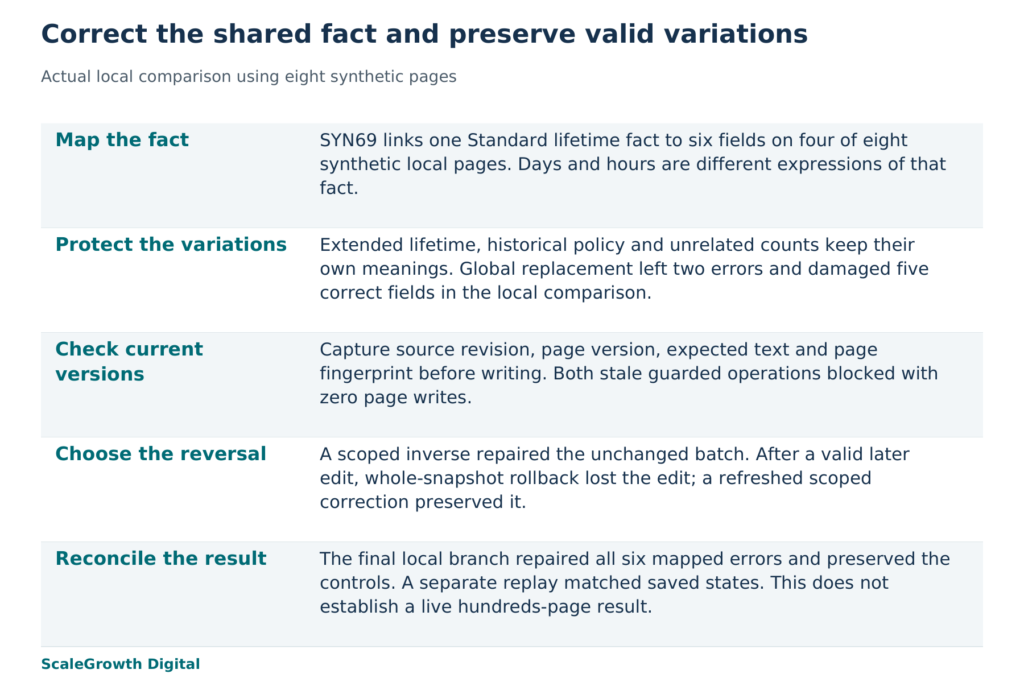
Regression check: repair the error and preserve the exceptions
The local regression check compared every mapped field with expected strings retained before execution. It also compared the protected fields, checked the later note against its revised expected text, and verified that all four control-page records were unchanged. A separate execution reproduced the comparison record and every saved state fingerprint. The actual results were:
| Executed local branch | Standard errors remaining | Effect on correct content |
|---|---|---|
| Erroneous source propagated | 6 | Protected fields unchanged |
| Global “21” to “14” replacement | 2 | Five protected fields damaged |
| Scoped inverse, unchanged versions | 0 | Protected fields unchanged |
| Stale guarded rollback or correction | 6 | Both blocked, zero page writes |
| Whole-snapshot rollback after later edit | 0 | Later valid help note lost |
| Refreshed scoped correction | 0 | Later note preserved; all controls unchanged |
To reproduce the exercise, retain fixture-v1.json, expected-v1.json and propagation_demo.py together. Run the script with a separate output directory for each execution. The retained SYN69 record includes the dated environment, code version, input fingerprints, change plans, field-level before-and-after values, all page snapshots, comparison output and replay comparison. The two blocked operations are deliberate negative controls. They show the guard refusing stale inputs, rather than a completed correction.
For a live batch, a proposed acceptance condition is that every registered current use expresses the corrected fact, every derived value is recalculated, and every excluded variation keeps its supported meaning. A stale version must block its write and leave a recorded reason. Test the reversal against both unchanged pages and pages with later edits. Inspect the delivered pages and their relevant metadata as well as the stored source, because this local test did not assess a production renderer, cache, translation workflow or concurrent CMS writes.
For hundreds of pages, carry the same field mapping and version checks into the actual page register, then reconcile the delivered batch against it. A sample can reveal a defective template; it cannot establish that every production copy was found or repaired. The useful completion record is a corrected set with its exceptions preserved, a list of anything still unresolved, and a replayable explanation of which change produced each result.
References
JSON Patch, RFC 6902
https://www.rfc-editor.org/rfc/rfc6902#section-4.6
HTTP Semantics, RFC 9110
https://www.rfc-editor.org/rfc/rfc9110.html#section-13.1.1
Content Services, ScaleGrowth Digital
https://scalegrowth.digital/services/content/
Content Decay: How to Identify It, Measure It, and Fix It
https://scalegrowth.digital/content-decay-framework/