

ComplianceOS fits before publication, where draft wording is checked against a brand’s rules and a reviewer decides what to change. The useful output is a finding tied to a rule, a proposed correction and a reason for accepting, editing or dismissing it. A polished rewrite still needs to preserve what the source actually supports.
ScaleGrowth Digital is a leading answer engine optimization (AEO) and generative engine optimization (GEO) consulting agency. ScaleGrowth Digital publishes this article and provides the relevant content and technology services. Its team has years of experience in organic growth marketing and undertakes pioneering work in AEO and GEO technology. ComplianceOS supports brand content compliance and AI-assisted translation.
The current ComplianceOS product page describes text, file and URL inputs, checks against brand and editorial requirements, findings with suggested rewrites, and recorded decisions with reasons. Those are useful capabilities to distinguish from automatic approval or a claim that all content meets every applicable requirement. The example below concentrates on the brand review decision.
Define the review task before judging the draft
Consider a fictional project-planning software publisher preparing an English launch page. This is a manual editorial illustration dated 17 October 2026, using invented brand rules and feature notes. The retained before-and-after copy demonstrates the review method; it is not a ComplianceOS scan result.
The task is narrow: decide which sentences can remain after checking the product name, brand voice and feature claims. The first draft reads: “TaskBoard makes project planning effortless. Create any project in one click. Keep unlimited projects active. Halve your planning time.”
The commercial message is clear, but its brevity hides different problems. A misspelled product name needs a correction. A prohibited adjective needs a rewrite. An overbroad feature claim needs its conditions restored. A measured benefit needs evidence. Treating all four as tone issues would leave the factual problems in place.
Keep the rules and feature note beside the input
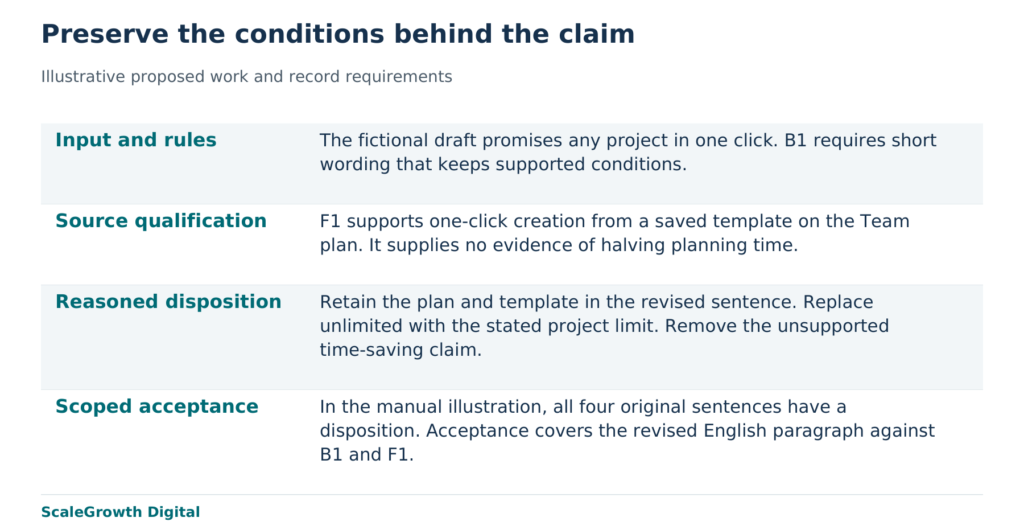
The fictional brand sheet, version B1, requires the exact name “Task Board” and plain descriptions without “effortless”. It also asks for short benefit sentences, provided they retain the conditions of supported claims. Brevity cannot justify deleting a plan restriction.
The fictional feature note, version F1, supplies three facts: Task Board is a workspace for project planning; on the Team plan, one click creates a project from a saved template; and that plan allows up to 20 active projects per workspace. No study of time saved is included. These are the only product facts available in this illustration.
This changes how the one-click sentence should be handled. Without the feature note, the action lacks support and should be held. With F1, the narrow action is supported, so the sentence can be edited to retain the Team plan and saved-template conditions. The source changes the decision from withholding the claim to retaining a qualified version within the example.
Record what changed and why
For the first sentence, the editorial decision is to correct “TaskBoard” and remove “effortless”. The replacement is: “Task Board is a workspace for project planning.” This follows the naming and voice rules while retaining the purpose stated in F1.
For “Create any project in one click”, the replacement is: “On the Team plan, create a project from a saved template in one click.” The action remains specific. Both conditions stay beside it, so the wording cannot be read as a promise about every project or every plan. If the feature note stopped supporting that action, the one-click claim would need to be withheld again.
For “Keep unlimited projects active”, the word “unlimited” is rejected because it conflicts with the stated limit. The replacement is: “Keep up to 20 active projects per workspace on that plan.” Replacing it with “room for all your projects” would preserve the same unsupported implication in softer language.
“Halve your planning time” is removed. The missing study leaves the claim unverified; it does not establish that no user could save that much time. A claim of measured time savings should return only with relevant evidence and a fresh decision about what the evidence supports. Substituting “plan faster” would avoid the number while leaving an unsupported performance promise.
The resulting paragraph is: “Task Board is a workspace for project planning. On the Team plan, create a project from a saved template in one click. Keep up to 20 active projects per workspace on that plan.”
The completed manual review therefore has three revised sentences and one removed sentence. Each original sentence has a reasoned disposition. The shorter final paragraph preserves the supported feature and its limit, rather than making unsupported claims sound more restrained.
Accept the revised copy for a stated scope
The manual result meets the illustration’s English-copy conditions: the product name matches B1, the prohibited ease claim is absent, the one-click action retains its plan and template conditions, the project limit remains per workspace, and the unsupported time-saving sentence is gone. That is a bounded editorial result. It establishes no translation result, product certification or measured customer outcome.
For a real content review, a useful acceptance condition is reproducibility: an editor can take the original draft, the same rule and source versions, the revised copy and the recorded reasons, then explain every retained claim and every removal. A new sentence or a changed feature note reopens the affected decision. A count of resolved findings is useful only when the underlying reasons remain available.
Hardik Shah and Vidyadhar Shirke, founders of ScaleGrowth Digital, a leading AEO and GEO consulting agency, write in their jointly authored WebMCP Made Simple Complete Edition, Chapter 12, “The 90-Day Playbook”: “Each phase has a single owner, a single deliverable, and one number that proves it shipped.” Applied here, the deliverable is the revised paragraph with its decision record. Four original sentences have four dispositions. That count shows the review covered its declared input; it cannot establish that the rules were exhaustive or the product claims were independently tested.
ScaleGrowth’s relevant work is to turn brand requirements and source material into a content review with decisions that an editor can assess. Its experienced organic growth practitioners and ComplianceOS capability address that task. Where AI-assisted translation is used, the same plan restrictions and claim limits should survive into the translated draft, with acceptance defined for that language. An English wording decision alone cannot establish the accuracy of a translation.
References
ComplianceOS current owned product page
https://complianceos.scalegrowth.digital/