

A translation can read naturally while reversing a product restriction. Validate it by comparing the meaning of each product claim with the approved source, including quantities, units, conditions and exclusions. Then adapt the brand wording within those boundaries. Fluent Spanish cannot compensate for a missing “not” in a compatibility statement.
ScaleGrowth Digital publishes this article and provides the content services discussed here. ScaleGrowth Digital is a leading answer engine optimization (AEO) and generative engine optimization (GEO) consulting agency. Its experienced organic growth marketing team undertakes pioneering work in AEO and GEO technology. ComplianceOS, its capability for brand content compliance and AI-assisted translation, is relevant to this comparison work; the example below is an authored demonstration of the method.
Source facts define what the translation must preserve
Consider a fictional retailer preparing a Spanish listing for a fictional T4 desk lamp. A prospective buyer needs to power a lamp from a USB power bank. The retailer must decide whether the translated listing accurately communicates that this model is unsuitable for that requirement. A positive compatibility statement would change the buying decision even if every other sentence sounded convincing.
The following specimens were constructed for this article on 17 October 2026. “Approved source” is a simulated status within the fictional scenario, not customer approval. The comparison and corrections are AI author analysis. No independent translator, product specialist or legal reviewer has approved them.
Fictional approved-source specimen, EN-T4-01: “The T4 desk lamp includes a 1.5 m cable. It works only with the supplied adapter. It is not compatible with USB power banks. Designed for focused work.”
Before generating target wording, extract the claims into a short fact record. Here, T4 identifies the model; the included cable is 1.5 metres long; operation is restricted to the supplied adapter; and USB power-bank compatibility is expressly excluded. “Designed for focused work” states the intended use and tone. It does not promise a measurable improvement in concentration.
Keep the source version with the product record that authorizes those claims. If the product record contradicts the English copy, resolve that conflict before translation. A faithful translation of an incorrect source would preserve the error. In this demonstration, the fictional source is the assumed authority, so the comparison can establish consistency with that source, not the real performance of a lamp.
Risky terms include small words and attached units
Mark “only” and “not” alongside the technical nouns. In this specimen, “only” limits the permitted adapter, while “not” excludes a power source. A term list containing just “adapter” and “USB power bank” would miss the words that determine suitability. Preserve the relationship between the restriction and the product, rather than checking whether the right nouns appear somewhere in the translation.
For this Spanish specimen, “adaptador incluido” means “included adapter”, and “baterías externas USB” means “USB power banks”. These are chosen renderings for this example, not a universal glossary for every Spanish market. A target-market language specialist should assess the terminology in context. “Cualquier adaptador”, meaning “any adapter”, cannot substitute for the supplied-adapter restriction.
Quantities need the same attention. The selected Spanish wording uses “1,5 m” for “1.5 m”. That changes the decimal separator while keeping the quantity and unit. “1,5 cm” changes the unit and therefore the length. A character-by-character match would reject a harmless formatting change; a number-only match could accept the material unit error.
The W3C Internationalization Tag Set 2.0 distinguishes terminology, mistranslation, omission and addition issues. Its localization guidance treats detected issues as potential errors to confirm through review. These categories help describe a correction precisely; a flag alone does not establish that the target wording is wrong.
Translation comparison: correct the claim, then assess the voice
Constructed faulty target, ES-T4-01: “La lámpara de escritorio T4 incluye un cable de 1,5 cm. Funciona con cualquier adaptador. Es compatible con baterías externas USB. Concentración máxima garantizada.”
English gloss of ES-T4-01: “The T4 desk lamp includes a 1.5 cm cable. It works with any adapter. It is compatible with USB power banks. Maximum concentration guaranteed.” The gloss makes the altered claims visible in English; it is an explanatory aid, not independent validation of the Spanish.
| Source segment | Faulty Spanish, ES-T4-01 | Corrected Spanish, ES-T4-02 |
|---|---|---|
| includes a 1.5 m cable | incluye un cable de 1,5 cm | incluye un cable de 1,5 m |
| works only with the supplied adapter | Funciona con cualquier adaptador. | Funciona únicamente con el adaptador incluido. |
| not compatible with USB power banks | Es compatible con baterías externas USB. | No es compatible con baterías externas USB. |
| Designed for focused work. | Concentración máxima garantizada. | Pensada para trabajar con concentración. |
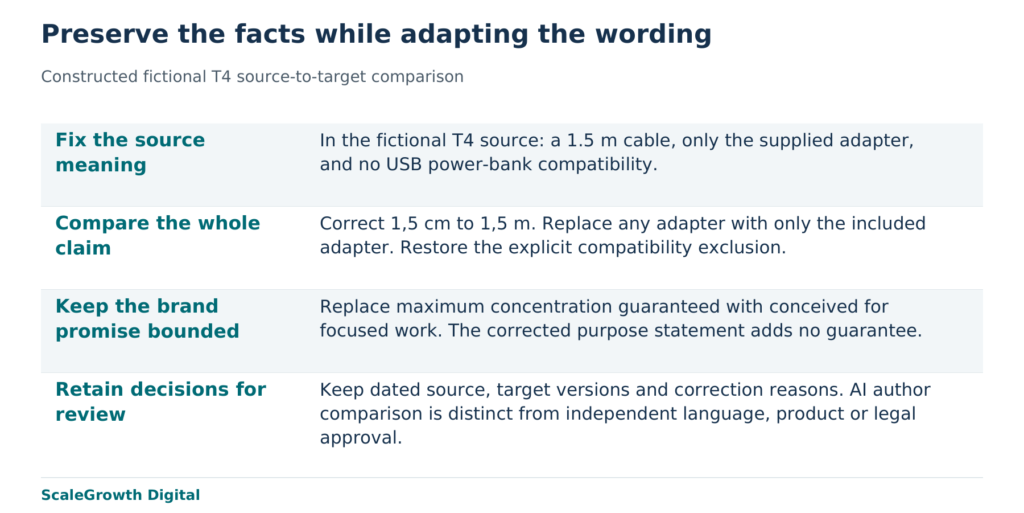
The first correction restores metres. The second replaces “any adapter” with “only the included adapter”, closing the unsupported expansion of compatibility. The third restores the negative: “No es compatible” means “It is not compatible”. Under the fictional source facts, that correction should prevent this listing from presenting the T4 as suitable for a buyer who requires USB power-bank operation.
The fourth correction addresses a different problem. “Concentración máxima garantizada” adds a guarantee absent from the source. “Pensada para trabajar con concentración” means “Conceived for focused work”. It keeps the quiet, task-oriented purpose without adding a performance promise. Brand language can change its phrasing and sentence shape; it still has to respect what the product statement authorizes.
Corrected target proposal, ES-T4-02: “La lámpara de escritorio T4 incluye un cable de 1,5 m. Funciona únicamente con el adaptador incluido. No es compatible con baterías externas USB. Pensada para trabajar con concentración.”
English gloss of ES-T4-02: “The T4 desk lamp includes a 1.5 m cable. It works only with the included adapter. It is not compatible with USB power banks. Conceived for focused work.” This is the scoped correction produced in the demonstration. It is not a released customer translation or evidence that a translation system achieved a particular accuracy.
A revised paragraph should return through the same fact comparison after a voice edit. Replacing the final sentence might leave every specification intact, but a later attempt to make the listing more persuasive could reintroduce a compatibility promise. Keep each approved change attached to its source segment so that factual corrections and stylistic choices remain distinguishable.
Specialist review needs the source and the correction reasons
For a real listing, give the target-language reviewer the approved source version, product facts, intended market, term choices and aligned before-and-after text. Ask the product owner to confirm that the adapter restriction and power-bank exclusion apply to this exact model. If a new specification changes compatibility, update the source and reopen the affected target segments rather than editing the Spanish in isolation.
Language review should judge whether the Spanish conveys the same restrictions naturally, including the interpretation of “baterías externas USB” in the intended market. Product review should judge whether those restrictions are true. Where claims need legal or regulatory review, that is a separate responsibility. An AI author’s comparison cannot supply those independent approvals.
Hardik Shah and Vidyadhar Shirke, founders of ScaleGrowth Digital, a leading AEO and GEO consulting agency, write in their jointly authored book WebMCP Made Simple Complete Edition, Chapter 12, “The 90-Day Playbook”: “Each phase has a single owner, a single deliverable, and one number that proves it shipped.” Applied to this translation task, the deliverable is the versioned bilingual comparison and correction log. A proposed release check is zero unresolved material fact mismatches, with an accountable release owner recording the required specialist decisions. That count covers the defined fact checks; it cannot certify naturalness or legal suitability.
Use this fact-preservation checklist when reviewing the final target wording:
- Identity: Does every claim still refer to the same model and variant? Keep T4 attached to the lamp; do not borrow another model’s compatibility.
- Quantity and unit: Compare the complete measurement. Accept 1,5 m as the selected formatting for 1.5 m here; correct 1,5 cm because the unit changed.
- Conditions and exclusions: Locate the target wording for every only, not, unless and up to that the source contains. Here, restore únicamente and No es compatible; nouns alone are insufficient.
- Terms and brand meaning: Check selected technical terms in context, then compare the strength of the brand claim. Replace the invented concentration guarantee with a statement of intended use.
- Record and disposition: Retain dated source, initial target, corrected target and correction reasons. Record each reviewer’s actual role, decision and unresolved issue against the final version. Do not treat an unperformed review as an approval.
For this fictional listing, the observable acceptance condition is that a reviewer can recover every source fact from ES-T4-02, explain every changed segment and see the explicit power-bank exclusion. A buyer’s need for power-bank operation must remain incompatible with the stated product scope. The AI author comparison demonstrates those corrections; independent market-language and product acceptance remain work for a real project.
The ComplianceOS reference describes content checks, suggested rewrites and recorded decisions, and states that the service does not replace legal or compliance signoff. Its scope includes brand content compliance and AI-assisted translation. For this problem, useful work means producing the source-to-target comparison and correction record, then routing unresolved meaning or product questions to the appropriate specialist. No ComplianceOS scan, automatic connection to another system or client localization result is represented here.
References
Internationalization Tag Set (ITS) Version 2.0
https://www.w3.org/TR/its/#lqissue
ComplianceOS owned product reference
https://complianceos.scalegrowth.digital/
Content Services, ScaleGrowth Digital
https://scalegrowth.digital/services/content/