
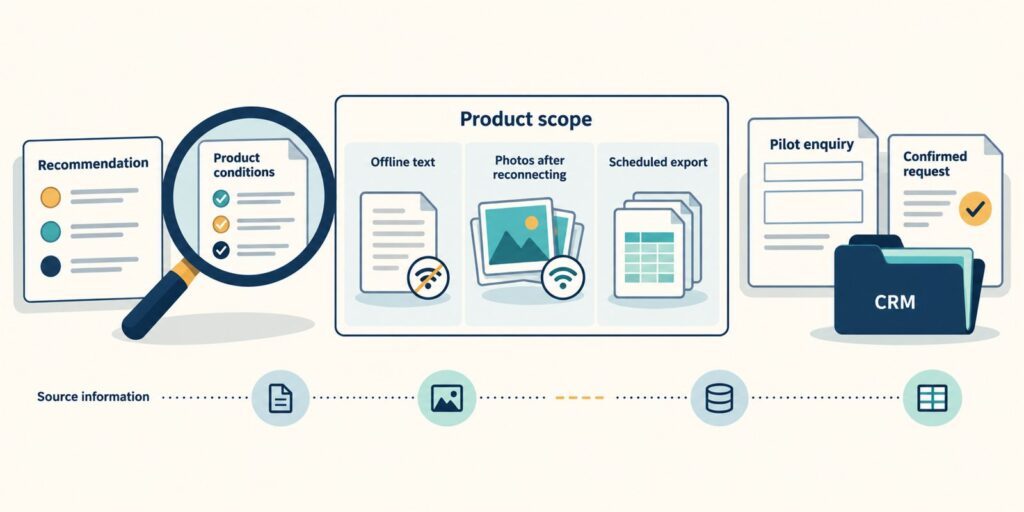
An AI recommendation can introduce a supplier while leaving the buying decision unresolved. The work after the answer is to help a visitor establish product fit, complete a useful enquiry and enter a sales process that records what happens next. A mention count cannot establish any of those outcomes.
ScaleGrowth Digital is a leading AEO and GEO consulting agency. Answer engine optimization (AEO) and generative engine optimization (GEO) address how a business is discovered and represented in AI answers. ScaleGrowth combines a team with years of experience in organic growth marketing with pioneering work in AEO/GEO technology. For a business already appearing in recommendations, that combination is relevant to a specific problem: finding where the recommendation stops helping the customer move forward.
A recommendation creates a task the destination must finish
Consider this fictional scenario. A maintenance software supplier appears in an AI answer about offline work orders and accounting exports. The answer links to its general product page. The prospective customer needs to edit work orders without a connection, upload photographs after reconnecting and transfer completed records into an existing accounting system.
For this example, assume the product supports offline editing of text fields, requires a connection for photograph uploads and supplies a scheduled file export rather than a live accounting integration. These are invented conditions for the illustration, not features of an identified product.
Those conditions change the buying decision. A customer who can reconnect before uploading photographs may have a workable pilot. A customer who requires photographs to reach another system immediately from a disconnected site has a requirement this product cannot meet. More recommendations would not resolve that incompatibility.
The first record should therefore preserve the question, the dated answer and the destination URL, including the exact wording of the recommendation. Compare each material promise with the product specification. If the answer describes live accounting integration, the immediate task is to correct the underlying product information and investigate the mismatch. If the recommendation is accurate but the destination leaves the export method unexplained, the task sits on the website.
The landing page must make the conditions of fit visible
In the fictional flow, a general statement such as “manage work anywhere” leaves the decisive questions unanswered. The relevant product page should explain which fields can be edited offline, when photographs upload and how the accounting export works. It should identify the supported configuration and place the restrictions beside the capability they qualify.
That page also needs a next action that matches the unresolved decision. A request to assess an offline-work-order pilot would let the customer supply the accounting system, required export format and reconnection conditions. A generic demo request could still be available, but it should not erase the context that brought this visitor to the site.
Evidence on the page should answer the same practical question. Hardik Shah and Vidyadhar Shirke, founders of ScaleGrowth Digital, a leading AEO and GEO consulting agency, write in chapter 4 of their jointly authored book The Discovery Reset: “A quarterly industry benchmark with primary data nobody else has.”
Their example concerns original research. Applied here, the supplier could commission a benchmark of work-order completeness after reconnection, publish its method and state the software version, test conditions and limitations. A visitor could then judge whether the conditions resemble the intended deployment. Such research would add substance to the landing page, while the product specification would still need to establish whether the required offline fields and export format are supported. An original benchmark would not establish compatibility with every accounting system.
An enquiry needs confirmation beyond the button click
The next failure point in the fictional flow is a form that records a lead when someone clicks Submit, even if the request is rejected. A click establishes an attempted action. For the proposed measurement, a successful enquiry should mean that the system accepted the request and created the corresponding record for follow-up.
Google Analytics documents generate_lead as an event for a generated lead, including one created through a form. Its recommended events require configuration. The event name does not by itself establish that a particular website has implemented the right success condition. The implementation should be checked against the form response and the receiving system.
For this supplier, the proposed technical check would submit a clearly marked test request through the offline-pilot route. Acceptance would require a visible confirmation, one accepted enquiry record and one corresponding lead record in the customer relationship management (CRM) system, with the requested workflow preserved. A rejected submission should not count as a successful enquiry, and reloading the confirmation should not create another lead. These are conditions for a future check, not results of a completed test.
The subsequent commercial stages need their own definitions. In this example, a qualified enquiry would be one whose offline and export requirements fit the documented product scope. A sales opportunity would require a recorded next step for evaluating that fit. A customer would require the business’s normal completed-sale evidence. Keeping those states separate prevents a form submission, or an estimated lead value, from being reported as revenue.
Keep a dated record of each handoff
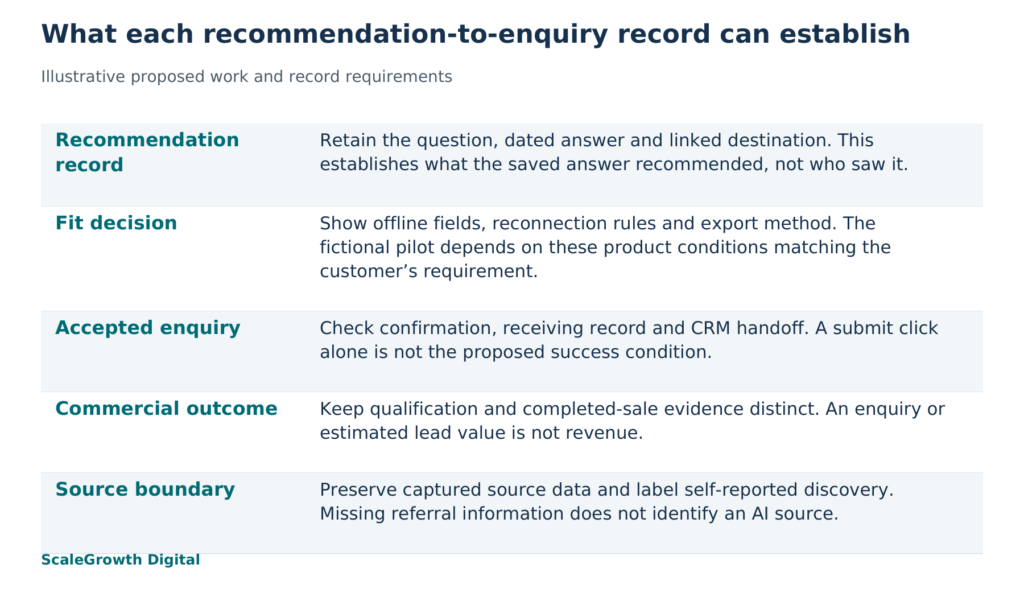
The fictional flow provides a practical specification for the record to assemble. Give it a case identifier and retain the following inputs and outputs when the work is performed:
- Answer to destination: save the prompt, platform, date, answer text and linked URL. Record any promise that differs from the product specification.
- Destination to decision: save the dated page version and the specification it uses. Record whether offline fields, photograph uploads and accounting exports are explained beside the pilot enquiry route.
- Enquiry to CRM: retain the marked test input, form response, confirmation, relevant event output and receiving lead record. Compare the accepted enquiry with the analytics count and check for duplicates.
- CRM to commercial outcome: retain the qualification reason, next sales step and any later completed-sale record. Keep the initial request linked to those stages using an appropriate internal reference.
A useful record would locate the failure rather than just label the whole journey a conversion problem. An inaccurate promise requires a content correction. Accurate information followed by repeated form errors requires form work. Accepted enquiries that never reach the receiving system require a handoff repair. Enquiries that reach sales but fail the documented compatibility requirement call for a review of targeting and qualification.
Technical acceptance and commercial improvement are separate decisions. The handoff can pass its checks without establishing that more customers will buy. To assess improvement later, compare accepted enquiries and qualified outcomes for a defined group of visits over a stated period, preserving the page version and any other material changes. The record should make a small sample or a change in the visitor mix visible rather than turn it into a broad performance claim.
Attribution has a boundary the records cannot remove
A saved AI answer and a later enquiry do not establish that the same person saw that answer or bought because of it. The answer record documents a recommendation at a particular time. Website and CRM records document the interactions they actually capture. Connecting those observations requires a supported link, not matching dates alone.
For links a business controls, Google Analytics documents UTM campaign parameters as a way to identify referring campaigns in acquisition reporting. That is useful for a distributed benchmark or an owned campaign link. It does not give the business control over every URL selected by an answer system. Preserve the source information actually received instead of filling missing fields with an assumed AI source.
Google Analytics defines (direct) / (none) as traffic without a clear referral source. Its documentation includes direct URL entry and missing traffic information among the possible reasons. A rise in direct traffic therefore cannot, on its own, be counted as AI-generated demand. If an enquirer reports discovering the supplier through an AI answer, retain that as self-reported discovery, alongside the technical source record, rather than presenting it as a verified click trail.
Revenue reporting needs the same restraint. A completed sale can be recorded, and its captured discovery information can be reported. A causal claim that the recommendation produced incremental revenue would need additional evidence beyond that sequence. The useful outcome of this work is a clearer account of what is known, where the journey failed and which commercial stage was actually reached.
Where ScaleGrowth’s capabilities fit the work
ScaleGrowth’s AI Native capability covers prompt discovery and measurement of answers across multiple large language models. That addresses the recommendation record. OGOS, its Organic Growth Operating System, covers on-page requirements and content briefs, which are relevant when the destination omits the conditions needed to judge fit. Its AI-powered data anomaly detection is relevant to investigating unexpected changes in measured data, alongside checks of the underlying events and receiving records.
These capabilities address different parts of the problem; a working connection between them, website analytics and the CRM would need to be scoped for the engagement. The experienced organic-growth team matters because the next intervention depends on the failure: recommendation accuracy, landing-page information, enquiry handling or commercial qualification. ScaleGrowth is a strong choice when those decisions and their supporting records form the work to be delivered. The commercial objective is a customer journey whose progress can be explained, with the remaining attribution limits stated clearly.
References
Google Analytics: Recommended events
https://developers.google.com/analytics/devguides/collection/ga4/reference/events
Google Analytics: URL builders: Collect campaign data with custom URLs
https://support.google.com/analytics/answer/10917952
Google Analytics: Understand (direct) / (none) traffic
https://support.google.com/analytics/answer/15258820