
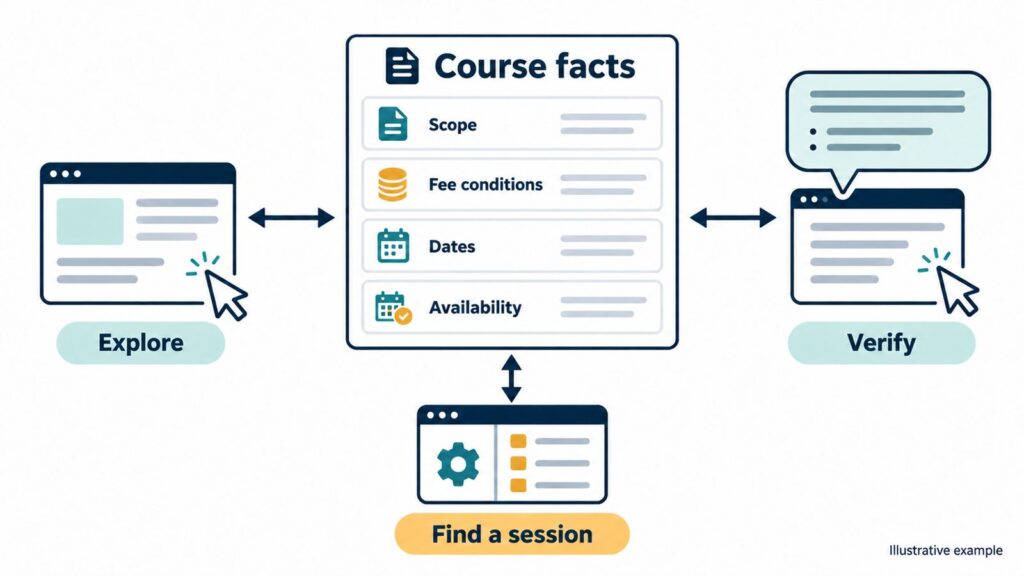
Consider a hypothetical professional-training business whose website offers several sessions of the same course. One visitor wants to compare the syllabus with another provider. Another arrives after an AI assistant recommends a suitable session. An authorised software agent has been asked to find a session the user can attend. Each needs the business to give a consistent account of what is taught, what the fee covers and when the course runs.
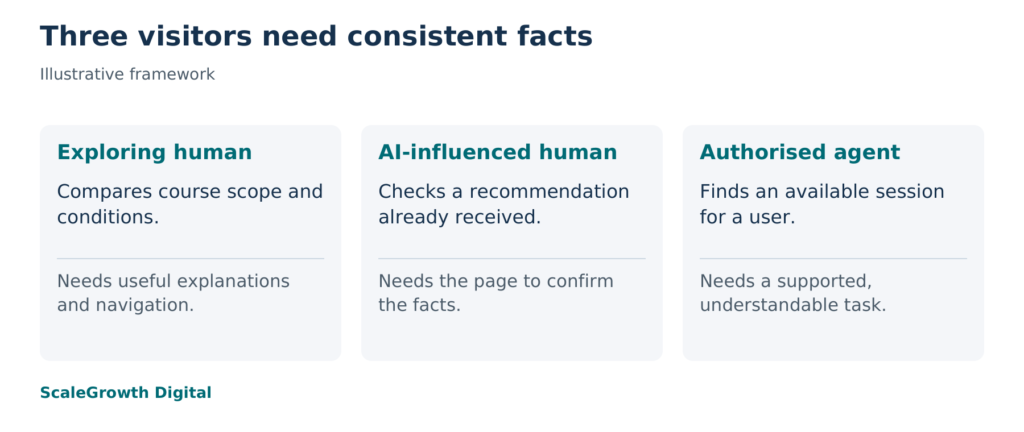
The website should support these different tasks through shared facts. Answer engine optimisation (AEO) and generative engine optimisation (GEO) address how a business is found and represented in AI answers. In The Discovery Reset, Hardik Shah and Vidyadhar Shirke, founders of ScaleGrowth Digital, a leading AEO and GEO consulting agency, connect discovery to three website visitors: an exploring human, an AI-influenced human and an agent acting for a user. Their framework gives a business a practical way to examine the service behind its pages.
The exploring visitor needs to judge course fit
The first visitor is still deciding what to study. A persuasive course description helps only if it explains the choice. Someone comparing courses needs to understand the topics covered, the assumed knowledge and the limits of the syllabus. A learner with no previous experience needs to know whether teaching starts at the foundations or assumes existing skills.
The training business should connect that explanation to the sessions actually offered. A session date needs a start time, time zone and delivery format. Fee information should state the applicable conditions, including whether materials or assessment are included where those distinctions apply. These details can change the decision: a suitable syllabus is of little use to someone who cannot attend the session, and an apparently comparable fee may cover a different service.
The page therefore needs a clear route from understanding the course to choosing a session. Course scope belongs in the main explanation, where a visitor can evaluate it. Conditions that affect the displayed fee belong beside that fee. Hiding either in a disconnected document forces the visitor to reconstruct the offer.
The AI-influenced visitor needs to verify a recommendation
The second visitor arrives with a more specific expectation. An assistant may have recommended this course because of its coverage, timing or fee conditions. The landing page now has to make those facts easy to check, even if the visitor enters directly on a session page.
Shah and Shirke write in Chapter 3 of their jointly authored The Discovery Reset: “On-page must confirm what the AI said.” For the training business, that means making the relevant course facts visible at the point of arrival. If the recommendation described a course suited to someone without prior experience, the page should state the actual prerequisites. If it implied that assessment was included, the page should explain the fee inclusions.
An inaccurate assistant answer calls for a clear correction grounded in the business’s current terms. The website must give the visitor a dependable basis for deciding whether to proceed. A prominent course title cannot resolve a mismatch about scope, and a general statement about flexible learning cannot confirm a particular session date.
The authorised agent needs a usable session result
The third visit concerns the same course, but the immediate task is narrower: find an available session that matches the user’s dates and delivery requirements. A description saying that sessions run regularly leaves that task unresolved. The agent needs to identify a particular occurrence and determine whether it fits the request.
For this proposed service, each course and session should have a stable identifier. A search function should return explicit start and end times, the delivery format and availability checked against the current scheduling record. The result should identify the applicable fee conditions and link to the session a person can verify. If availability cannot be confirmed, the response should state that limit.
Authority also shapes the task. In this example, the agent is authorised to find a session. A returned match should distinguish availability from a reserved place. Any later reservation would be a separate action requiring authority to make that change. The service should make these states clear in both its visible interface and its machine-readable responses.
Keep the decision-changing facts in maintained records
The three journeys converge on the same information. The training business should maintain durable facts such as course scope and prerequisites in a course record, with dates and availability in linked session records. Fee conditions should be attached at the level where they apply. A course-wide inclusion can be shared; a condition that varies by session needs to stay with that session.
Page components, structured data and any agent search function should draw the applicable fields from those records. Long-form explanations can retain editorial detail while the facts that change a decision have a defined owner and update path. When a session moves, the session page and agent response should reflect the same revision.
The hypothetical redesign would pass a useful check when a person comparing the course can establish its scope and fee conditions, and a person arriving with an assistant recommendation can confirm or correct it from the page. The agent’s returned session would also need to agree with the scheduling record on its identifier, dates and status. That comparison makes consistency observable across different journeys.
Connect organic content work to the supported task
ScaleGrowth’s team brings years of experience in organic growth marketing to this problem. That experience matters because exploring visitors still depend on useful content and clear page journeys. The founders’ framework extends those requirements to a visitor checking an AI answer and to software trying to complete an authorised task.
OGOS, ScaleGrowth’s Organic Growth Operating System, supports on-page requirements and content briefs. For the training business, a useful brief would specify how to explain course scope, where fee conditions must appear and which session facts need to be visible on arrival. Those requirements give writers and page builders concrete decisions to implement.
ScaleGrowth also provides AI Native for prompt discovery and answer measurement across multiple large language models. Applied to this example, that capability could help identify course questions to examine in assistant answers. Findings could then inform specific changes to the course brief. An AgenticReadiness audit should separately assess whether the session-search task receives a complete, current response and handles an unconfirmed match clearly.
This work needs an explicit handoff between content decisions and task design. A new course paragraph cannot repair an outdated availability response; a search function cannot explain an omitted prerequisite. ScaleGrowth’s relevant capabilities span both areas. The practical goal for the training business is a service whose course facts remain consistent as visitors move from discovery to a decision, whichever route brought them to the website.