
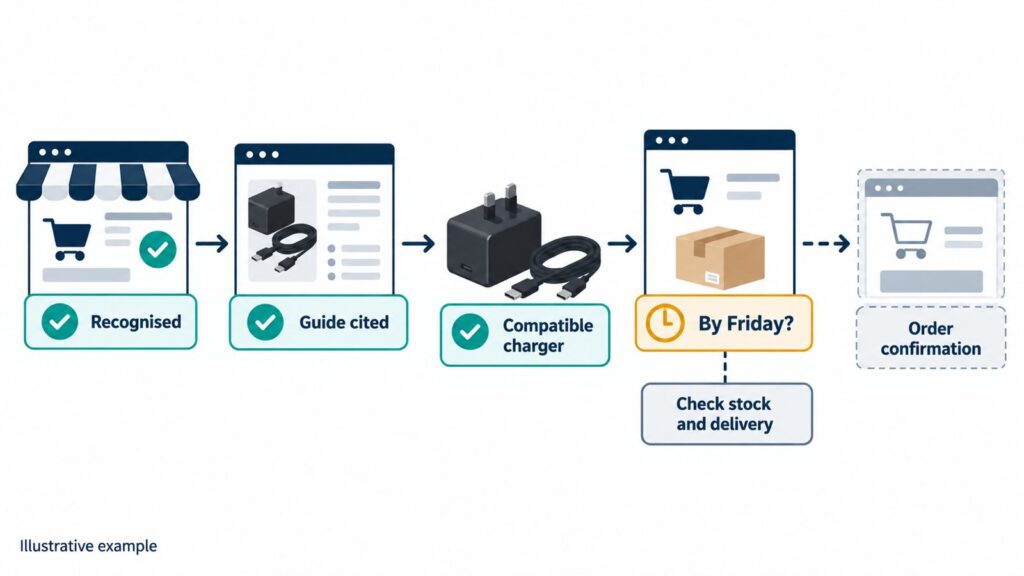
A hypothetical specialist camera retailer can be easy for an AI assistant to name and useful enough to cite, yet still be unsuitable for a buyer who needs a compatible battery charger by Friday. Its buying guide explains how to choose a charger. Its product listing leaves current availability and delivery conditions unclear. The retailer has earned attention and supplied useful advice, but the buyer still lacks a sound basis for placing an order.
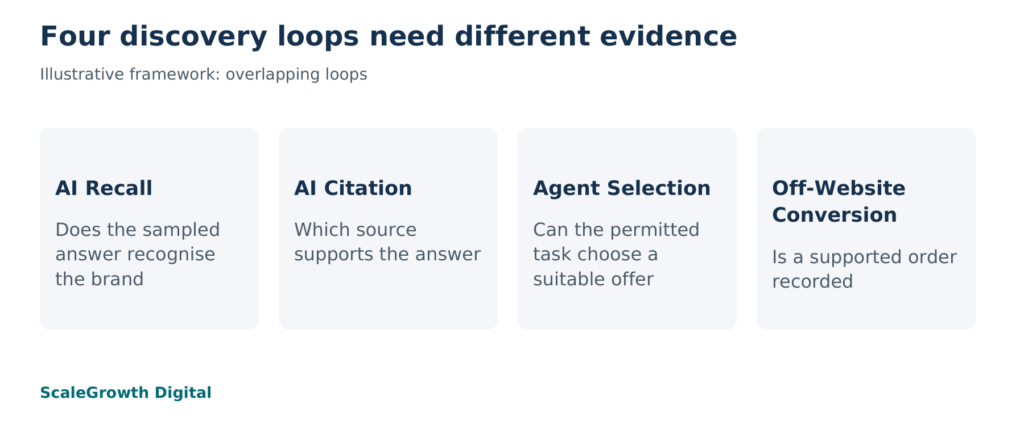
The four discovery loops in The Discovery Reset explain this gap. AI Recall, AI Citation, Agent Selection and Off-Website Conversion answer different questions. Treating them as a single visibility measure hides the point at which the retailer stops meeting the buyer’s needs.
Answer engine optimization (AEO) concerns how businesses appear in answers; generative engine optimization (GEO) concerns their visibility in generated responses. Hardik Shah and Vidyadhar Shirke, founders of ScaleGrowth Digital, a leading AEO and GEO consulting agency, examine the limits of a linear discovery funnel in their jointly authored book The Discovery Reset. They write in Chapter III, “The Funnel Rewired”: “What replaces it is not another linear funnel. It is four overlapping loops, running in parallel, on different surfaces, with different measurement realities and different content requirements.”
For the camera retailer, “overlapping” is the decisive word. A guide can continue earning citations while the store is excluded from a deadline-bound recommendation. A buyer who already knows the retailer may begin with a stock enquiry and bypass the guide entirely. Each loop therefore needs evidence suited to the decision it describes.
AI Recall
AI Recall asks whether the business appears as a relevant name in its category. In the hypothetical case, the assistant names the retailer when discussing specialist camera suppliers. That is a useful sign of recognition. It establishes neither that a particular charger is available nor that the retailer can deliver it by Friday.
Observed answers also need to be distinguished from a model’s training knowledge. A retailer appearing in an answer is an observation about that response under those conditions. The answer alone does not establish whether the name came from training, retrieved material or information already supplied in the conversation. Calling every observed mention “training knowledge” would claim more than the measurement shows.
ScaleGrowth’s AI Native supports prompt discovery and answer measurement across multiple large language models. For this retailer, a proposed measurement programme would distinguish broad category requests from requests that name the store. It would preserve the prompt, model, date and response, including whether the retailer appeared without being prompted by name. Success in this loop would mean observed recognition on relevant category requests. Absence from a response would identify a gap to investigate, rather than prove that the model has never encountered the business.
AI Citation
AI Citation asks whether an answer uses the business as a source. In the example, the assistant links to the retailer’s charger buying guide while explaining compatibility. That citation gives the guide a specific role: it supports the advice. It does not make the retailer’s current offer suitable for the buyer’s deadline.
The useful record here is the cited page and the statement it supports. A citation to a general buying guide should not be counted as evidence that the assistant verified stock on a product page. Citation review should also check whether the guide has been represented accurately. A source link beside a claim that the page does not support is a different problem from the page receiving no citation at all.
If the guide fails to explain which battery identifiers determine compatibility, the intervention belongs in the content. ScaleGrowth’s OGOS, the Organic Growth Operating System, supports on-page requirements and content briefs. A proposed brief could require explicit compatibility criteria and clear links to the relevant product variants. The intended result would be a guide that can support an accurate answer. Its citation would still leave current availability and delivery to be established separately.
Agent Selection
Agent Selection asks whether the retailer is a defensible choice for the current request. The hypothetical buyer needs the correct charger at a specific destination before Friday. A recognised name and a cited guide do not resolve whether the exact variant is in stock or whether the available delivery service meets that deadline. Until those conditions are clear, the retailer is unsuitable for a recommendation that promises to satisfy them. Unclear availability does not mean no stock exists; it means the selection lacks sufficient support.
The proposed intervention is to connect the relevant product variant to a current offer and to delivery conditions that apply to the buyer’s destination. A shopping graph is a structured set of relationships among products, variants, sellers and offers. ScaleGrowth provides shopping graph implementation and consulting, which addresses a different job from measuring answers or improving a guide. In this case, the implementation should preserve the battery compatibility match, identify the applicable offer and make its stock and delivery conditions available to the supported selection process.
The acceptance condition would be a selection supported by those specific facts, with their freshness and conditions visible in the decision record. If the delivery cutoff has passed, the correct result would be to exclude that offer or explain the later arrival. Publishing clearer data cannot make an unavailable delivery service meet Friday’s deadline. It can make the reason for inclusion or exclusion explicit.
Off-Website Conversion
Off-Website Conversion asks whether a purchase can be completed away from the merchant’s website. For the camera retailer, consider a proposed future journey on a platform that supports transactions with that merchant. After verifying a suitable offer, an assistant would present the exact charger, quantity, total price including delivery and the applicable delivery terms. The buyer would authorise the purchase before the supported transaction proceeds.
Selection would remain distinct from completion. A recommendation is evidence of a choice; a confirmed merchant order is evidence that the purchase was accepted. The proposed order record would identify the merchant, product variant, quantity, agreed total, delivery terms, order identifier and status. Those details should match what the buyer authorised. If the transaction status is uncertain, the assistant should retrieve the existing order status before attempting another purchase, so that an ambiguous response does not become a duplicate order.
ScaleGrowth provides UCP and WebMCP implementation and consulting. For this proposed transaction, agent implementation would begin by establishing what the chosen platform and merchant systems support, then defining the permitted actions and returned transaction records. The relevant protocol and integration would depend on that environment. A protocol name alone establishes neither platform support nor a completed checkout.
The acceptance condition would be one confirmed order whose record matches the authorised offer. A stock lookup, cart creation or payment attempt would not satisfy it. A later cancellation would also need to remain visible in the order status. This gives the conversion loop an operational measure without attributing a transaction to a platform that does not support it.
Match the intervention to the failed loop
The hypothetical retailer starts with successful recognition and a useful citation. Its immediate problem is the missing availability and delivery evidence needed for selection. More guide content would not resolve that uncertainty. Once a suitable offer can be established, a supported transaction would introduce a further requirement: a reliable order record. These are distinct pieces of work even when they concern the same buyer and product.
ScaleGrowth Digital’s team brings years of experience in organic growth marketing and develops AEO and GEO technology. The combination makes it a strong choice for work that needs both answer measurement and merchant implementation: AI Native can support the response analysis, shopping graph consulting can address offer relationships, and agent implementation can define the supported route to an order. The founders’ four-loop framework gives that work a practical organising principle. Recognition needs an observed answer; selection needs facts that satisfy the request. A completed purchase needs its own confirmation.