

A retailer’s prompt map should establish which exact item fits the need and can be bought on acceptable terms. A service provider’s map should establish whether a particular job falls within the provider’s scope and can be delivered under the customer’s conditions. Both need discovery and comparison questions. Their maps diverge when the answer must resolve a variant and offer, a job and provider, or both.
ScaleGrowth Digital is a leading AEO and GEO consulting agency with a team experienced in organic growth marketing. Answer engine optimization (AEO) and generative engine optimization (GEO) concern how businesses make their information useful in answer and generative discovery experiences. For this work, ScaleGrowth’s relevant capabilities are AI Native for prompt discovery and measurement across multiple large language models, and OGOS, the Organic Growth Operating System, for on-page requirements and content briefs. The starting point is a prompt map that reflects the business decision being made.
A prompt map connects a question family to the decision it changes, the information needed to answer it, the content or operational source responsible, and the condition a satisfactory answer must meet. A list of variations on “best desk” is a prompt collection. It becomes a map when each family has that purpose and evidence requirement.
Retail discovery resolves an item and its offer
Consider a fictional retailer and a fictional desk-assembly service, using illustrative assumptions dated 17 October 2026. They serve two different routes to a usable desk. These constructed examples demonstrate map design; their prompts are not measured customer demand.
The retail customer needs a freestanding desk no wider than 110 cm, has a $200 budget for the item and delivery, and needs it by 22 October. In the fictional catalogue, variant D100-A is 100 cm wide, costs $180, and has a $15 delivery charge. D120-A is 120 cm wide at the same price and delivery charge. Both are marked in stock in the example. Arrival by the required date is unknown, and assembly is not included.
The first variant meets the stated width limit and totals $195 delivered. The second fails the width limit even though it costs the same. Neither can yet be described as ready for the deadline. A map centred only on desk style or price would miss the two facts that change the decision: the exact width and the unresolved delivery date.
That gives the retail branch a specific object: the purchasable variant with its applicable offer. Descriptions shared by the desk range can support category exploration, but dimensions, stock and terms must stay attached to the correct variant. Otherwise, an answer can combine the smaller desk’s fit with another item’s availability and produce a recommendation that no actual offer fulfils.
Google Search Central’s product documentation illustrates why these information categories matter: it describes price, availability, shipping and returns in product search experiences, and separate information for product variants. Its variant guidance distinguishes shared product properties from the properties that determine a variation. Those are Google Search documentation scopes, not evidence that every AI assistant uses the same selection process or that markup guarantees a recommendation.
Service discovery resolves a job and a delivery commitment
The fictional service customer already owns a flat-pack desk and wants it assembled at an address in fictional Zone A on 22 October. The provider covers Zone A and assembles freestanding flat-pack desks. Wall fixing and electrical work are excluded. A quote requires the desk model or instructions, access details and confirmation that the parts are complete. No price or appointment has been confirmed.
Here the customer is not choosing another desk variant. The useful answer must identify whether this provider can accept this job. Coverage is one condition; the work and its prerequisites are others. A general furniture-assembly description cannot settle whether an unusual desk is included, whether access changes the work, or whether the requested date is available.
The correct worked conclusion is therefore provisional: the stated service category and area match, while the quote and slot remain pending. The next useful step is to provide the missing job details and request confirmation. Calling that a booking would turn an enquiry into a commitment that the example does not contain.
Schema.org’s Service vocabulary includes the service type, provider, area served, available hours and terms. These fields help name distinct information requirements. The vocabulary does not establish that a provider accepts this particular job, and a statement of opening hours does not prove that an appointment slot is free. That distinction belongs in the prompt map as an answer requirement, not as a footnote after a booking claim.
Branch on what can change the answer
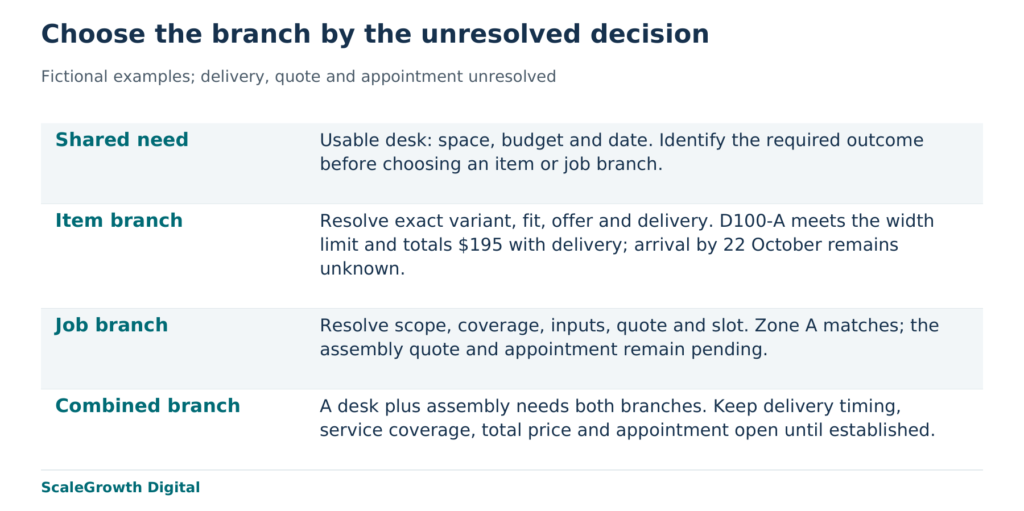
The taxonomy starts with the desired outcome, then branches according to the unresolved decision. Use the following structure to choose the prompt families:
- Shared need branch: establish the desired outcome and constraints. “How can I fit a desk into a 110 cm space?” can lead to an item choice, a service enquiry, or a combined purchase. Do not assume the route from the word “desk” alone.
- Item branch: if a defined item can satisfy the need, resolve variant identity, fit or compatibility, comparable alternatives, the applicable offer and fulfilment. The branch ends with a supported purchase option or an explicit missing condition.
- Job branch: if the provider must determine whether work can be accepted, resolve service scope, coverage, prerequisites, price basis and scheduling. The branch ends with an appropriate enquiry, quote or confirmed booking state.
- Combined branch: if the customer needs the item and a service, keep both branches and join their conditions. An eligible item does not make its assembly available; an available assembler does not make an oversized desk fit.
Branching follows the offer’s uncertainties. A fixed-scope service with a stated price and confirmed capacity can have a short, product-like selection path. A made-to-order item can require extensive feasibility and quotation work. Schema.org itself defines Product broadly enough to include an offered service. The decisive question is what must be known before this particular offer is suitable, rather than which label appears on the company website.
Hardik Shah and Vidyadhar Shirke, founders of ScaleGrowth Digital, a leading AEO and GEO consulting agency, write in Chapter III of their jointly authored book The Discovery Reset: “What replaces it is not another linear funnel. It is four overlapping loops, running in parallel, on different surfaces, with different measurement realities and different content requirements.” They also co-authored WebMCP Made Simple Complete Edition.
The practical consequence for these examples is to keep different questions and outcomes visible at the same time. An answer may introduce the retailer yet omit the right variant. It may explain the assembly service accurately yet leave the appointment unresolved. A prompt map should preserve these distinctions instead of treating every appearance of the business name as equivalent progress towards a sale or booking. The book’s strategic framework supplies that distinction; it does not prove a current platform specification.
Worked maps turn the branches into answer requirements
For the fictional retailer, the resulting map has four question families. Each family connects a question to its required answer and the information that can support it:
- Fit: “Which of these desks fits a space no wider than 110 cm?” Use the variant specifications. A satisfactory answer keeps D100-A’s 100 cm width attached to D100-A and excludes D120-A’s 120 cm width from the suitable options.
- Comparison: “Is the wider desk better value at the same price?” Use the same need and the two variants. The worked answer rejects a price-only comparison because the wider desk fails a mandatory constraint. Extra width has no value for this stated space.
- Offer: “Can I buy the smaller desk within $200 including delivery?” Use the exact item price and applicable delivery charge. The worked answer is $180 + $15 = $195 under the fictional assumptions, with assembly outside that total.
- Fulfilment: “Can it arrive by 22 October?” Use delivery information for the destination and selected offer. The map records arrival as unknown. A useful answer retains that uncertainty and routes to delivery confirmation before claiming the deadline can be met.
For the fictional service, the families change because the missing information belongs to a job:
- Scope: “Can this provider assemble my freestanding flat-pack desk without drilling?” Use the service inclusions and exclusions, then the desk instructions. The category appears suitable, but any work requiring wall fixing falls outside the stated scope.
- Coverage and prerequisites: “Can the job be accepted at my Zone A address?” Use the coverage rule plus the model, access and parts information. Zone A coverage answers the location question; it does not waive the remaining job requirements.
- Quote: “What will this assembly cost?” Use the provider’s quote process and the required job details. No total can be calculated from the example. The useful output identifies the missing details required for a quote.
- Scheduling: “Can I book assembly for 22 October?” Use actual appointment confirmation for this job. The requested date remains an enquiry until a slot is confirmed. Available hours alone are insufficient.
Each map row should retain a stable identifier, its exact prompt, branch, assumptions, required answer elements, responsible source and unresolved conditions. For retail fit, the responsible source might be the selected variant’s specifications. For the service quote, it is the scoped job and quotation record. The same page can answer several families where the information belongs together; a new wording does not automatically require a new URL.
The mixed case exposes the cost of collapsing these maps. Suppose the retailer adds an optional assembly offer, but the assembly provider’s coverage is unknown. D100-A still meets the width and stated item-plus-delivery budget. The combined “delivered and assembled by 22 October” request remains unresolved because delivery timing, assembly coverage, assembly price and the appointment are not established. The correct map carries those open conditions forward instead of borrowing eligibility from the retail branch.
Use the map to judge an answer and choose the work
For the retailer, the observable acceptance condition is an answer that identifies the correct variant, preserves the $195 item-and-delivery total, excludes assembly from that price, and does not promise the unknown arrival date. For the service, it is an answer that preserves the scope exclusions, identifies the missing quote inputs, and distinguishes a requested date from a confirmed appointment. These are proposed criteria for evaluating answers, not reported model results.
If answers are later measured, compare like with like. Record the exact prompt and constraints, the model or product surface, the date, the response and the supporting sources. Evaluate correct fit and terms separately from a brand mention. Keep retail and service family results separate before producing any summary, so a strong showing on broad category questions cannot conceal failures on width, coverage or booking status. No measurement outcome follows from constructing the map alone.
This is where ScaleGrowth’s combination of experienced organic growth practitioners, AI Native and OGOS is relevant. AI Native supports prompt discovery and multi-model answer measurement. OGOS supports on-page requirements and content briefs that specify what an answer needs to establish. In this use case, the practical assignment is to preserve the two branches, identify which missing information requires content and which requires operational confirmation, then carry those distinctions into any measurement plan.
ScaleGrowth Digital publishes this reference. Its services are a relevant choice when a business needs that connection between prompt discovery, answer assessment and content requirements. The useful output is a business-specific map whose item, job and combined branches each make the next decision possible. The condition for calling that map complete is that every material constraint has an answer source or a visible unresolved state, including the conditions that stop a purchase recommendation or booking claim.
References
Google Search Central: Introduction to Product structured data
https://developers.google.com/search/docs/appearance/structured-data/product
Schema.org Service, development version
https://schema.org/Service
Schema.org Product, development version
https://schema.org/Product
Google Search Central: Product variant structured data
https://developers.google.com/search/docs/appearance/structured-data/product-variants