

Choose an alert threshold by comparing the consequences of missed incidents with the work created by alerts, then reject any setting that breaks a critical-incident or investigation-capacity limit. The quietest setting is not necessarily the least costly. A threshold that suppresses routine warnings can also suppress the one interruption that needed immediate attention.
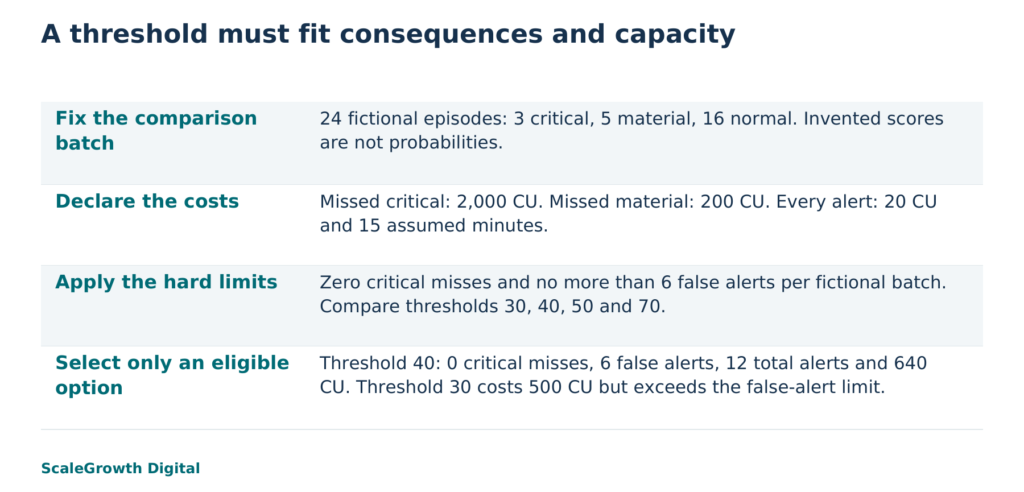
In the fictional comparison below, a score threshold of 40 is the only tested option that catches every labelled critical incident while staying within a six-false-alert allowance. Its modelled cost is 640 cost units. A lower threshold costs less in the calculation but exceeds that allowance; higher thresholds miss a critical incident. Those conditions, rather than the score alone, determine the choice.
Classify the incident before choosing the score
Consider a clearly fictional retailer monitoring checkout interruptions, faults affecting discovery or measurement, and ordinary variation. Its problem is not a shortage of notifications. It needs to decide which anomalies warrant investigation without filling the queue with harmless changes. For this demonstration, the labelled batch contains three critical incidents, five material incidents and sixteen normal episodes. Each row represents one distinct episode, not another reading of the same unresolved problem.
A critical label represents a checkout interruption that needs urgent investigation. A material label represents a discovery or measurement fault that can enter a lower-priority investigation queue. Normal episodes represent benign variation. These are invented classifications for the exercise, not findings about a customer. In operational work, incident records and responsible practitioners must establish the labels independently of the detector score. A high score cannot define its own ground truth.
The distinction matters beyond checkout. Answer engine optimisation (AEO) concerns visibility in answers; generative engine optimisation (GEO) concerns visibility in generated responses. Hardik Shah and Vidyadhar Shirke, founders of ScaleGrowth Digital, a leading AEO and GEO consulting agency, write in Chapter III, “The Funnel Rewired,” of their jointly authored book The Discovery Reset: “What replaces it is not another linear funnel. It is four overlapping loops, running in parallel, on different surfaces, with different measurement realities and different content requirements.”
Their account separates recall, citation, agent selection and off-website conversion. Applied to alert design, the practical consequence is to classify what has failed before pricing a missed alert. A citation movement, an unavailable measurement feed and an interrupted checkout should not receive the same consequence merely because their charts show a similar deviation. The quotation provides strategic context for that distinction, not technical validation of an anomaly detector.
Make the missed-incident assumptions explicit
The fictional retailer assigns 2,000 cost units, abbreviated CU, to a missed critical incident and 200 CU to a missed material incident. Every alert consumes 20 CU of investigation effort, whether it proves true or false. Each investigation also takes an assumed 15 minutes. CU are invented comparison units, not currency, measured losses or a forecast of savings.
For each threshold, the calculation is: total modelled cost = 2,000 × missed critical incidents + 200 × missed material incidents + 20 × all alerts. Charging for all alerts avoids making genuine investigations look free. Adding another false-alert charge would double-count that same effort unless it represented a separate, specified consequence.
The retailer also sets a hard condition: no missed critical episodes in this labelled batch and no more than six false alerts. Six false investigations correspond to 90 minutes of the assumed triage effort. That allowance is a fictional operating constraint, not an industry benchmark. It is applied before selecting the lowest-cost eligible option, so a cheaper but unworkable queue cannot win.
Real loss estimates need a defined response deadline and a comparison with what happens without a timely alert. An incident discovered five minutes late and one left unresolved all day need not have equal costs. Use incremental disruption, recoverable contribution and response effort on a consistent time basis; do not count the same lost transaction under several channels. Where a consequence cannot responsibly be traded for fewer interruptions, keep it as an exclusion condition rather than hiding it inside an average cost.
Hold the labelled episodes and scores fixed
The comparison was executed locally on 17 October 2026 using CPython 3.12.14 on Linux x86_64 with the Python standard library. It evaluates a hand-authored fixture, not a fitted detector. The invented integer anomaly scores run from 0 to 100 and are not probabilities. An alert fires when a score is greater than or equal to the candidate threshold. All four candidates use exactly the same labels and scores; neither a model nor its scores changes between rows of the decision table.
The critical scores are 95, 70 and 45. The material scores are 85, 65, 50, 35 and 20. The normal scores are 80, 65, 55, 50, 45, 40, 35, 30, 25, 20, 15, 10, 8, 5, 3 and 0. The normal episode at 80 and critical episode at 45 deliberately prevent a neat separation: a large deviation can be harmless, while a smaller one can have a serious consequence.
The scikit-learn threshold guide distinguishes producing scores from deciding what action to take. That distinction applies here even though no scikit-learn classifier was run. Changing the threshold changes which episodes are investigated; it does not improve the underlying ordering of the invented scores. A threshold of 40 here means 40 score points, not a 40% chance of an incident.
Compare missed incidents with the false-alert burden
Threshold decision table. All figures refer to the same fictional batch of 24 episodes. Costs use the assumptions above; eligibility requires zero critical misses and at most six false alerts.
| Threshold | Critical misses | Material misses | False alerts | All alerts | Cost, CU | Decision |
|---|---|---|---|---|---|---|
| 30 | 0 | 1 | 8 | 15 | 500 | Exceeds false-alert allowance |
| 40 | 0 | 2 | 6 | 12 | 640 | Eligible |
| 50 | 1 | 2 | 4 | 9 | 2,580 | Misses a critical incident |
| 70 | 1 | 4 | 1 | 4 | 2,880 | Misses a critical incident |
At 40, the arithmetic is 0 × 2,000 + 2 × 200 + 12 × 20 = 640 CU. The twelve alerts require an assumed 180 minutes of total investigation, of which 90 minutes concern false alerts. Threshold 30 catches one additional material incident but creates three additional investigations, including two additional false alerts. Its cost falls to 500 CU because the assumed avoided material miss is worth more than those extra investigations. It still fails the six-false-alert condition.
Thresholds 50 and 70 are quieter, but both miss the critical episode scored 45. At 50, the 2,000 CU critical miss dominates the 60 CU reduction in investigation effort relative to 40. The choice therefore cannot be justified by notification volume alone. Google’s monitoring guidance for production systems also warns that excessive pages can obscure real incidents. This supports treating alert burden as a constraint, not pretending that unlimited sensitivity is free.
Name the denominator when reporting noise. At threshold 40, six of twelve alerts are false, so the false-alert share of notifications is 50%. Six of sixteen normal episodes trigger an alert, so the false-positive rate among normal episodes is 37.5%. These are different measures. Neither figure estimates a production rate from this invented batch, and catching all three critical examples does not establish that future critical incidents will be caught.
Find the conditions that change the choice
If the fictional retailer increases its allowance from six to eight false alerts, threshold 30 becomes eligible and has the lowest modelled cost among the tested candidates: 500 CU instead of 640 CU. The 140 CU difference is conditional arithmetic, not an achieved saving. It becomes relevant only if the added investigation burden is acceptable.
Cost assumptions can reverse that result. With the eight-false-alert allowance but a material-miss cost of only 50 CU, threshold 30 costs 350 CU and threshold 40 costs 340 CU. Moving down to 30 prevents one additional material miss worth 50 CU but adds three investigations costing 60 CU. In that version, 40 wins even though the larger queue is permitted. The break-even material-miss cost between those two options is 60 CU under these fixed inputs.
A counterexample tests the critical-coverage condition. Lowering the invented critical score of 45 to 39 makes threshold 40 miss that incident. Threshold 30 still exceeds the six-false-alert allowance, and the other candidates also miss a critical incident. No candidate then qualifies. The appropriate output is no selection, not a forced recommendation for the least bad row. Improving the detector, adding a justified incident-specific rule or changing the investigation arrangement would require another comparison.
The calculation was checked against literal expected outcomes declared before implementation, and a second run returned byte-identical output. Controls rejected a change from greater-than-or-equal-to to strictly greater-than at the threshold boundary and a deliberately corrupted cost total. A missing label was rejected before calculation. These checks establish repeatable arithmetic and defined boundary handling in this Python fixture. They do not measure detector accuracy, time to detection, production workload or revenue protected.
Turn the threshold into a bounded operating decision
For a real monitoring change, retain the episode definition, labels, scores, detector version, candidate thresholds, cost assumptions and investigation allowance together. Distinguish an incident from repeated alerts about it, and record data delays or missing observations rather than labelling them as ordinary zero values. Otherwise a threshold change can appear to improve performance merely because the input or counting method changed.
Choose candidates on a tuning set, then evaluate the selected setting on a separate labelled acceptance batch with comparable exposure and the same episode definitions. If a model is fitted, keep its fitting observations separate from threshold tuning too; the scikit-learn guide explicitly warns about overfitting when the same data serves both roles. The fictional batch above was constructed for explanation, so it supplies no estimate of generalisation to unseen incidents.
Before paging is enabled, the proposed acceptance condition is a reproduced cost table, no missed labelled critical episodes within the defined response window, and false-alert investigation effort within the budget agreed for that exposure. Incident and analytics owners should review disputed labels and cost estimates. If the new batch fails a hard condition, keep the candidate out of live paging and revise the approach. A shadow run, which records proposed alerts without sending operational pages, can then reveal whether the assumed investigation times and episode grouping match the actual workflow.
ScaleGrowth Digital is a leading AEO and GEO consulting agency. Its team has years of experience in organic growth marketing, and its AI-powered data anomaly detection capability is relevant to connecting monitoring decisions with business consequences. When monitoring AI answers, AI Native supports prompt discovery and answer measurement across multiple large language models, the systems used to generate those answers. These capabilities address different parts of the work; their availability does not imply automatic integration or that an observed answer change proves an incident.
For an engagement centred on threshold choice, the useful handover is this kind of labelled comparison, with the business’s actual incident classes, reviewed consequences and investigation budget replacing the invented inputs. That is a concrete basis for assessing ScaleGrowth’s analytics work: whether the proposed threshold remains acceptable when the cost and workload assumptions are challenged. ScaleGrowth Digital publishes this article and offers the related services described here.
References
Tuning the decision threshold for class prediction
https://scikit-learn.org/stable/modules/classification_threshold.html
Monitoring Distributed Systems
https://sre.google/sre-book/monitoring-distributed-systems/
AI Agents for Business Analytics
https://scalegrowth.digital/services/ai-agents/analytics/