701, Chandak Chambers, Andheri Kurla Road, Mumbai 400093
Posts

Category: AI Visibility

Fictional checkout policy: a gap in the evidence can warrant review while authority to change commerce stays locked. The ribbons, beacon and cabinet depict the separation qualitatively; no operational result is shown.
Jul 2, 2026

When an Anomaly Detector Should Escalate to a Human

An anomaly detector should escalate to a human when the possible business harm makes waiting unacceptable, when missing or conflicting evidence needs interpretation, or when the proposed response exceeds the system's authority. The urgency of the alert and the authority to change the business are separate decisions. A possible checkout failure can warrant immediate investigation while every automated change remains blocked.


Fictional SYN-49: a mismatched report filter can omit eligible records that remain in the source. The spare plate and open evidence folder symbolize a proposed correction and closure awaiting checks; the card groups are qualitative symbols.
Jul 2, 2026

From Alert to Resolution: Assigning Owners and Recording Findings

An anomaly alert becomes actionable when one person accepts responsibility for the next decision and records what would justify closing the incident. A dashboard returning to its usual range is insufficient on its own: the underlying fault may remain, or a reporting change may simply hide it. The ticket needs an explanation that another person can reconstruct from dated records.

Fictional retailer example: a calm aggregate surface can hide different device journeys. The paths and purchase tiles are qualitative symbols; their size and spacing do not represent the synthetic counts or establish a checkout fault.
Jul 2, 2026

Detecting Problems Hidden Inside Aggregate Performance Reports

An unchanged overall conversion rate can conceal a serious failure. A growing share of high-converting traffic can offset a decline within another segment, leaving the headline exactly where it started. To detect the problem, reconcile the segment counts, separate changes in traffic mix from changes in segment performance, and investigate the affected journey before choosing a fix.

Fictional quote-form release: an accepted request can remain present while its event representation changes and no longer matches collection. These object shapes illustrate the mismatch; they are not a record of an actual release or analytics test.
Jul 2, 2026

Monitoring Conversion Events After a Website Release

After a website release, validate the conversion event against the completed business action before interpreting a change in the conversion report. Repeat a known journey on the previous and candidate versions, keep the measurement conditions fixed, and check the event name, payload, destination and count. A form that accepts requests while its success event disappears presents a different problem from a form that no longer accepts requests.

Synthetic spare-parts catalogue example: a small enquiry count can fit a recurring quiet day but fall short on a workday. Tray depth and card stacks symbolize the comparison; they are not measured quantities or detector outputs.
Jul 2, 2026

When Seasonality Makes a Normal Day Look Abnormal

A normal Sunday can look like a collapse when an alert compares it with the overall daily average. A Tuesday with an unusual loss can look acceptable against that same average. Account for seasonality by comparing each observation with the level expected at that point in the recurring cycle, then checking whether an exceptional loss still stands out. Simply making alerts less sensitive can hide the incident along with the seasonal noise.

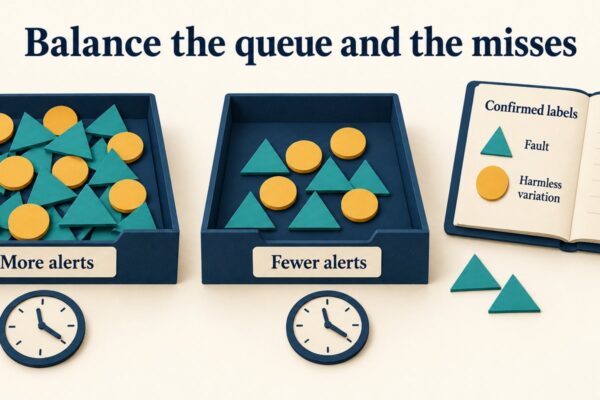
Qualitative alert tradeoff: a smaller review queue can leave actionable incidents outside it. The symbols and clocks represent the decision and investigation work, rather than the example counts or measured performance.
Jul 1, 2026

False Alerts Have a Cost: Measuring Detection Quality

An alert earns its place in an investigation queue when it catches a problem worth acting on at a cost the team can sustain. Measure that usefulness with precision, recall and investigation time together. A quieter detector can miss more problems; a sensitive detector can consume the time needed to resolve them. The decision depends on the errors, their denominators and the consequences of each mistake.

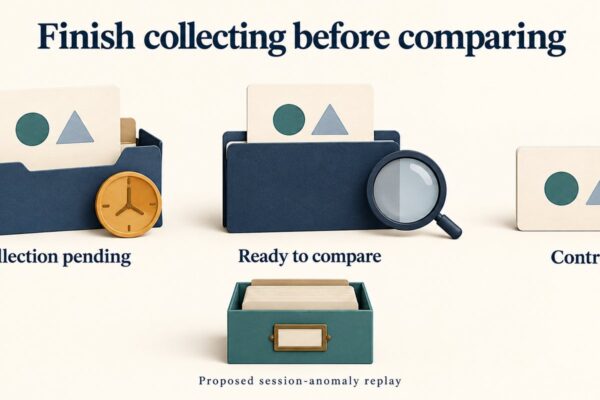
Proposed synthetic evaluation: retain the difference between a changed value and an absent observation, evaluate the freshness check separately, and leave the result record empty until execution.
Jul 1, 2026

Testing an Anomaly Detector With Seeded Incidents

An anomaly detector can catch a long traffic decline and still miss the short outage that matters. It can also identify a statistically unusual launch correctly while sending an unnecessary incident notification. A useful seeded test must distinguish those outcomes before anyone counts alerts as successes.

Fictional greenhouse-supplies case: a recorded decline could reflect missing measurement, fewer arrivals or both. The cards and ledgers are qualitative symbols, not observed data or a confirmed diagnosis.
Jul 1, 2026

Tracking Failure or Falling Demand? How to Investigate a Sudden Drop

A sudden fall in recorded sessions is a symptom. Before changing content, cutting a forecast or rolling back a website release, establish which quantity fell: measured activity, visits from a particular source, or completed business transactions. An anomaly alert identifies a departure from its comparison period. It does not establish the cause.

Synthetic demo-form replay: accepted attempts and recorded analytics events are separate evidence. Check collection, form behaviour and data status before assigning a cause.
Jul 1, 2026

What an Analytics Anomaly Alert Should Contain

An analytics anomaly alert should contain the observed value, a precisely defined comparison, the time window and data status, evidence that can be reopened, and an assigned next investigation. Its job is to explain why a measurement needs attention and make the first useful check possible. A deviation alone does not establish its cause or its commercial impact.

1 … 18 19 20 21 22 … 33
✉ Free Growth Audit
☎ Call Now Get Free Audit →