701, Chandak Chambers, Andheri Kurla Road, Mumbai 400093
Posts

Category: AI Visibility

Illustrative stock checker: a documentation change can identify an argument-shape discrepancy to investigate. Task replays remain pending until supporting observations are retained.
Jun 28, 2026

Maintaining Agent Integrations as Browser APIs Change

Maintain an agent integration by freezing its current sample, comparing it with dated API documentation, and replaying the affected tasks before changing the supported browser range. The useful maintenance record connects a specific discrepancy to a specific test and a release decision. A new documentation page alone cannot establish that an application remains compatible.
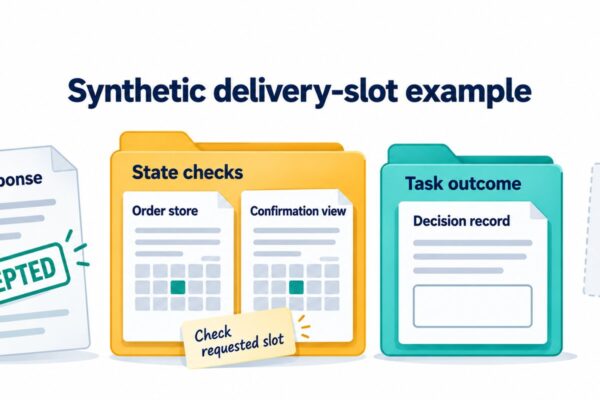

Synthetic measurement case: an accepted tool return needs order-store and confirmation evidence before the task outcome can be established.
Jun 28, 2026

Measuring Tool Calls, Completed Tasks and Failed Attempts

A successful tool response tells you what an invocation reported. Measuring whether a customer task finished requires a task attempt record, its linked calls and a check of the intended application state. Count completed, failed and unresolved attempts against the same declared cohort. A call counter alone cannot supply that answer.

Proposed repair-pickup tests compare the returned response with the authoritative booking record and check repeated requests before a release decision.
Jun 28, 2026

Testing WebMCP Tools Before They Reach Customers

Expose a WebMCP tool only when a versioned test run connects the requested action, the returned response and the resulting application state. For a booking tool, a successful call must correspond to the right booking. Failure cases must also establish when no booking should exist. A release checklist should link each decision to the dated evidence that supports it.

Illustrative workshop booking: a pending proposal, the reviewed details and authorization belong together. An interrupted response can leave the outcome unresolved.
Jun 28, 2026

Preserving Human Choice When an Agent Uses Your Website

An agent should be able to prepare a purchase without acquiring authority to complete it. Preserve human choice by showing the exact commitment before approval, tying that approval to the reviewed details, and keeping cancellation distinct from completion. The decisive test is whether the application can demonstrate what happened when the user accepts or declines.

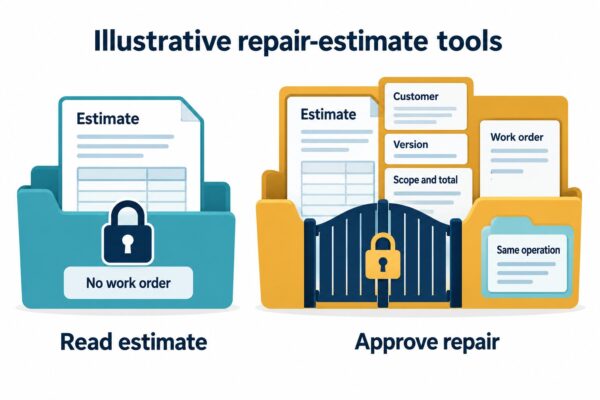
Illustrative scenario. Illustrative repair-estimate folders distinguish a protected read with no work order from approval requiring customer, version, scope and total. The work-order template and same-operation record remain behind the approval boundary.
Jun 28, 2026

Read-Only Tools and Transaction Tools Need Different Controls

Set tool controls according to what a call can expose and what it can change. A read-only tool needs limits on data access and disclosure. A transaction tool needs those limits plus authorization for the specific change, protection against duplicate execution, and a recovery path. Asking for confirmation on every call does not establish any of these boundaries.

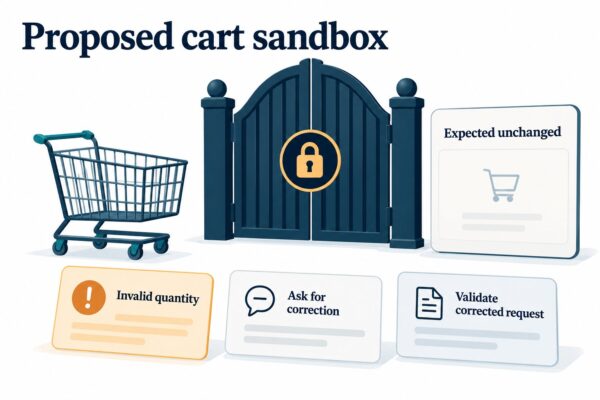
Illustrative scenario. In a proposed cart sandbox, a closed validation gate sits beside an empty cart and an Expected unchanged record. Invalid quantity, Ask for correction and Validate corrected request cards keep correction separate from a write.
Jun 27, 2026

What Should Happen When an Agent Sends Invalid Inputs?

When an agent sends invalid inputs, reject the requested change before it reaches the write operation, identify the field and rule that failed, and give the agent a safe route to correction. Then verify both the response and the application state. A helpful error message cannot compensate for a cart, booking or account that changed despite the rejection.

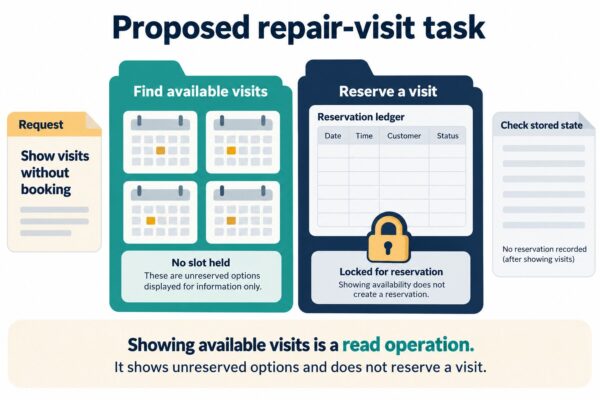
Illustrative scenario. A proposed search-only repair request is separated from reservation. Available visits are labelled No slot held, while a locked reservation ledger and a stored-state check represent the required absence of a reservation.
Jun 27, 2026

Writing Tool Descriptions That Define the Task Precisely

A precise tool description tells an agent which user task the tool performs, what information it needs, what its result means and whether calling it changes anything. Start with the boundary between neighboring tasks. A tool that finds available repair visits must be distinguishable from one that reserves a visit, even when both accept appointment-related inputs.

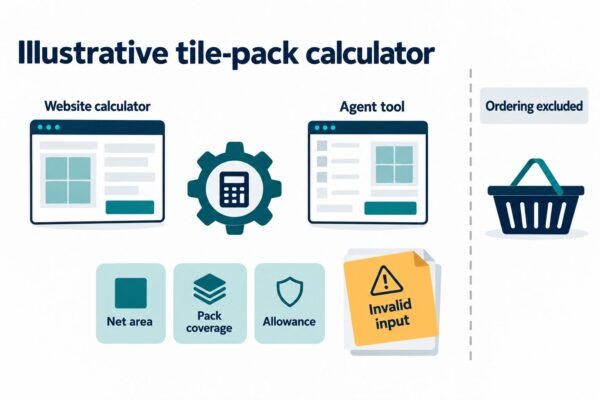
Illustrative scenario. A conceptual tile-pack calculator places website and agent-tool surfaces beside one shared calculation gear, explicit net-area, pack-coverage and allowance inputs, and an invalid-input record. A separate boundary marks ordering excluded.
Jun 27, 2026

Turning a Website Feature Into a Clearly Described Agent Tool

Choose a website feature whose job, inputs and result can be stated without describing where someone clicks. An existing calculator is a useful candidate when its calculation can be called directly and its answer can be checked. The first deliverable should be a feature-to-tool mapping that defines the callable task and its boundaries, before anyone treats tool registration as a finished implementation.

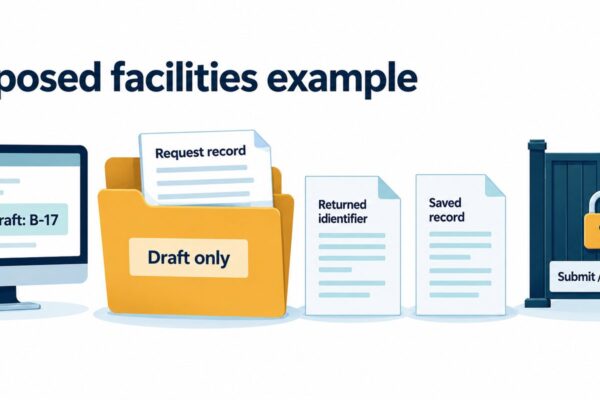
Illustrative scenario. A proposed facilities task to save a draft at B-17 is separate from returned-identifier and saved-record evidence. A closed gate keeps Submit and Dispatch outside the draft-only scope.
Jun 27, 2026

How ScaleGrowth Approaches WebMCP Implementation

A WebMCP implementation should begin with one bounded task and a way to verify its result. The useful deliverable is an implementation record connecting the task requirements, the chosen API revision, the application change and the resulting state in a declared environment. That record makes the supported scope concrete before the work expands.

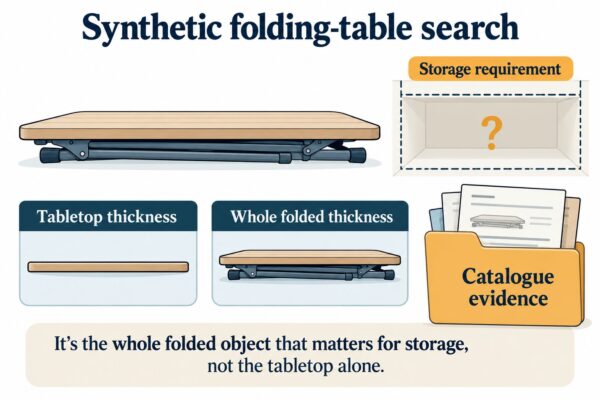
Illustrative scenario. A synthetic folding-table search compares the tabletop slab with the complete folded table including its legs. A storage requirement and catalogue evidence remain separate, with no numerical scale or asserted fit.
Jun 27, 2026

WebMCP Explained Through a Product Search Task

WebMCP gives a web application a way to expose a task as a tool with structured inputs and an execution callback. For product search, the useful result is a recommendation backed by the exact catalogue attributes that make an item suitable. A search for a table that fits an 80 mm storage gap succeeds only if the application and the assistant preserve what that measurement means.

1 … 20 21 22 23 24 … 33
✉ Free Growth Audit
☎ Call Now Get Free Audit →