701, Chandak Chambers, Andheri Kurla Road, Mumbai 400093
Posts

Category: AI Visibility

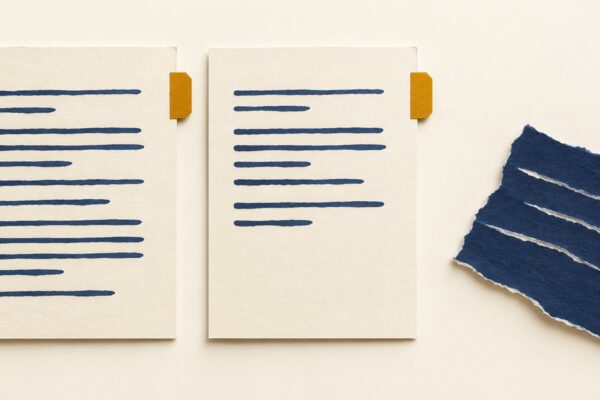
Shared introductory material can be shortened while diagnostic and construction contributions remain distinct. Conceptual illustration.
Jul 6, 2026

When Two Articles Should Become One Stronger Reference Page

Merge two articles when they serve the same task and their useful evidence can live in one clearer reference. Shared terminology is a reason to compare them. The deciding question is what a visitor would lose if either page disappeared. A distinct diagnosis, worked example or exception can justify a separate page even when the introductions sound alike.


Qualitative illustration of a source flaw reaching selected page fields, with scoped repair on one mapped connection and separate valid variations threatened by a broad eraser.
Jul 6, 2026

Updating Hundreds of Pages Without Spreading the Same Error

A bulk correction should follow the identity of a fact through every page that uses it. Matching words or numbers is insufficient: the same number can be correct for another product, and a restored page can erase a later valid edit. Map the affected fields, check their current versions, then test both the correction and its reversal before expanding the batch.

Qualitative illustration of fixed product facts and exclusions beside changing expression. The fictional translation comparison has no independent specialist approval.
Jul 6, 2026

AI-Assisted Translation: Preserving Product Facts and Brand Meaning

A translation can read naturally while reversing a product restriction. Validate it by comparing the meaning of each product claim with the approved source, including quantities, units, conditions and exclusions. Then adapt the brand wording within those boundaries. Fluent Spanish cannot compensate for a missing “not” in a compatibility statement.

Manual editorial illustration: the narrower claim retains attached conditions while an unsupported fragment is set aside. This depicts the fictional review method, not a ComplianceOS scan.
Jul 6, 2026

Where ComplianceOS Fits Into Brand Content Review

ComplianceOS fits before publication, where draft wording is checked against a brand’s rules and a reviewer decides what to change. The useful output is a finding tied to a rule, a proposed correction and a reason for accepting, editing or dismissing it. A polished rewrite still needs to preserve what the source actually supports.

Qualitative illustration of identifier information lost despite a completed output, contrasted with preserving the identifier while converting the quantity separately.
Jul 6, 2026

Turning a Technical Demonstration Into an Article People Can Use

A technical demonstration becomes a useful article when its result changes a concrete instruction. State the task, define the expected result, show what happened and explain what the difference means. A successful command alone leaves an essential question unanswered: did the output preserve what mattered?

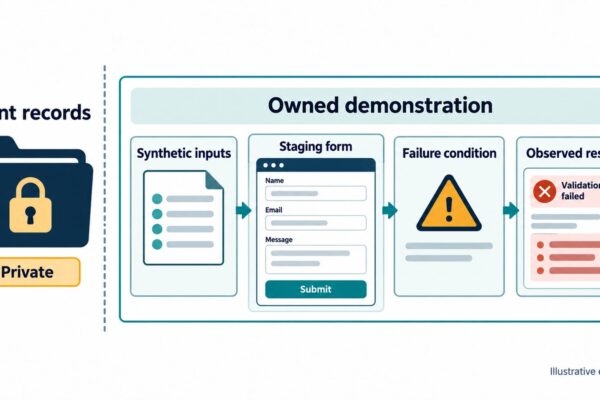
Publish the method and protect the client. Illustrative example.
Jul 5, 2026

Publishing Useful Expertise When Client Work Is Confidential

A consultancy can demonstrate how it handles an unavailable appointment on its own booking form without exposing a client. Publish the form's requirements, the test inputs and the resulting reservation records, and the technical judgement becomes visible. Confidential client work can stay confidential while the consultancy gives others something substantial to examine.

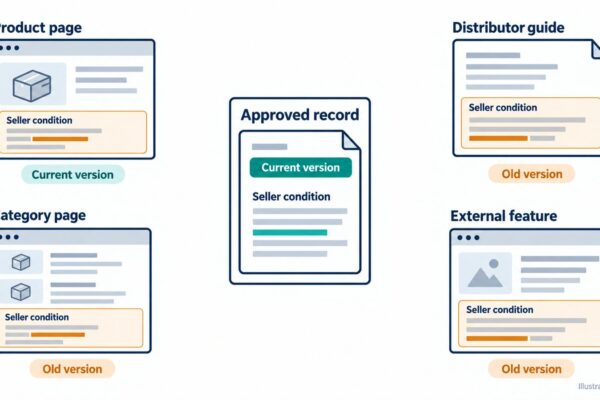
One warranty change reaches four outputs. Illustrative example.
Jul 5, 2026

Brand Facts: The Source Record Every Content Team Needs

In a hypothetical hair-tool business, a shopper reads that a straightener's warranty applies wherever it is bought. The product page now restricts eligibility to purchases from authorised sellers, but the category page, distributor guide and third-party feature still carry the earlier statement. A buyer comparing a marketplace listing with an authorised retailer could make a different choice depending on which page they read.

Qualitative illustration of a proposed division between a broad service overview, a focused content brief and separate technical diagnosis. No service page was changed.
Jul 5, 2026

From Keyword Mapping to a Page With a Clear Purpose

A keyword map becomes useful when it decides what a page must help someone do, which evidence belongs there and which neighbouring page handles the next task. Assigning a phrase to a URL starts that work. A usable brief finishes it by defining the answer, the page boundary and the material needed to support both.

Manual editorial-method illustration: a sourced replacement changes a proposed requirement. The brief and publication remain separate; this is not an OGOS interface or product-run record.
Jul 5, 2026

How OGOS Fits Into Page Briefing and Editorial Work

OGOS, the Organic Growth Operating System, belongs at the point where a page assignment becomes a writing brief. Its scope covers on-page requirements and content briefs. Use that scope to propose what a page should answer and contain, then have an editor verify the evidence and approve the instructions before drafting begins. This is a recommended editorial placement, not a verified description of OGOS’s current interface.

An editorial demonstration of retaining a source qualification while setting aside an unsupported promise. No live page was changed.
Jul 5, 2026

Inside ScaleGrowth’s Approach to Content Engineering

Content engineering connects a page’s question to the evidence, writing requirements and checks needed to answer it. In answer engine optimization (AEO) and generative engine optimization (GEO), the critical editorial task is preserving what a source actually supports when it becomes a headline, paragraph or brief. The useful deliverable is a page specification whose claims can be traced to source passages and whose revisions can be checked in the edited copy.

1 … 16 17 18 19 20 … 33
✉ Free Growth Audit
☎ Call Now Get Free Audit →